








How we train Digital Twins

Josh Feiber
July 30, 2026
august is built to get you closer to your customers, and their insights, faster. Modeled on real people who matter to your business, these digital twins help anyone on your team surface the kind of overlooked insight that usually takes weeks to find, in minutes.
What is a Digital Twin
At the core of august's platform is the notion of a Digital Twin. A Twin is a digital representation of a real person who is important to your business. For commerce it's a customer, for SaaS it's a user of an app, for a website it's a visitor, and so on. Each twin corresponds to a specific individual, and we can generate twins for any population where we have the ability to collect anonymized behavior data.
How we create a Digital Twin
The core of how august creates a Digital Twin is based on two premises:
- No one model for human behavior, decision-making and personality is completely accurate.
- LLMs are the best model for predicting a word based on context that we have ever seen.
Our approach fuses these two premises together. Multiple different models on how to represent human behavior are trained per individual and then used together with an LLM to form a conversable Digital Twin. If LLMs are the next step forward in word/token prediction, august is the next step forward in human behavior prediction.
What actually forms a twin and how is it represented
A twin is formed by three major components:
- Behavioral, decision-making and personality traits
- Memories
- Reflections
Behavioral, decision-making and personality traits
In order to encapsulate human behavior and tendencies, we generate a collection of behavioral, decision-making and personality models per individual. At a high level, these models fall into three buckets:
- Psychometric models
- Cognitive-affective processing system (CAPS)
- Decision-making models
The first bucket, psychometric models, includes traditional models for personality and values, similar to HEXACO or Schwartz Theory of Basic Human Values. The second major bucket, CAPS, is essentially a massive block of if-then patterns. If an individual was in situation A it resulted in action X; if an individual was in situation B it resulted in action Y; etc. The third major bucket, decision-making models, depends on the context in which we're training twins. If the twins are being trained for a commerce website where prices for goods are displayed then we may use behavioral economics theories such as Prospect Theory to model commerce-specific decision-making tendencies like price sensitivity or loss aversion. In other contexts where we are generating twins for users of an app where there is no behavioral economics at play we use more general models for human decision-making.
Memories
Each twin has a concept of memory, which is formed from the interactions with your business of the real individual that the twin corresponds to. A memory is a neutral, natural-language recollection of an episodic experience with your business. For commerce businesses this may be a session on your website or an interaction with a support agent, for SaaS apps this may be a session in your app or an interaction with one of your Account Managers or CSMs, and so on. Each interaction with your business or product can generate one or several memories depending on the relative importance of what occurred. Taking an example of a SaaS app, a twin for one of the app's users may generate these two memories from a session in the app:
Spent just under an hour on desktop working across catalog management, funnel building, and offer management. Edited two products, worked extensively inside a shop funnel editor, and made adjustments to two offers — including a gift-with-purchase and an amount-off-products offer. Toggled the one-time purchase setting repeatedly while configuring the funnel, and also opened the Variants and Edit Virtual Product areas. Saved work at least once before wrapping up.
Hit an error while working — the app failed to load the product "Beam Dream" and displayed an error message.
Each memory is stored along with an importance score (scale 1-10) and the date it occurred.
Reflections
Once a twin has enough memories to meet an importance threshold, we compute a reflection. A reflection connects memories together and generates a higher level of self-understanding and knowledge. Continuing the SaaS app example above, a twin for one of the app's users may have a reflection that looks like:
Cycling back to Dynamic Product Pages and the review section over and over isn't checking them off — it's getting the storefront-facing result right. Keep pasting content above existing blocks, swapping imagery, toggling layout options, then jumping to an external preview to see how it actually lands on the page. The review section gets revisited the same way: not to confirm it's done, but to keep watching how the built thing reads to whoever lands on it.
When/how do these get computed
The primary source for the above is anonymized interaction and session recording data, supplemented by integrations with support platforms and CDPs to capture other touchpoints. Each week we recompute the behavioral, decision-making and personality traits for each twin based on the corpus of session recording and interaction data we have collected. These traits change slowly (if at all) and so they are computed relatively infrequently. The memory → reflection cycle is computed daily as they occur much more frequently. Fresh memories are created from new sessions or interaction data we've ingested, and reflections computed for any twins that reach the memory importance threshold.
Creating a conversable Digital Twin
The modeling, memory and reflection system described above happens continuously in the background as part of our training pipeline. At runtime when a twin is invoked in an interview, focus group or survey, we distill these three components into a system prompt that is injected into an LLM. The behavioral, decision-making and personality traits are represented in the system prompt as model values or natural language descriptions of particular traits, and all traits are pulled into the system prompt.
The same is not true of memories and reflections, as twins may have thousands of memories that would quickly dominate the context window of an LLM. We pull a relevant set of memories and reflections for a given conversation based on vector similarity to the conversation context so that only the most relevant memories/reflections are recalled. For example, if you run a focus group asking for feedback on three ad creatives for bicycles, twins in the focus group will treat memories and reflections that reference bicycles as more relevant and prefer to recall those first. This working set of memories and reflections then gets sorted by importance, relevance to the conversation context (vector similarity) and recency when injected into the system prompt. As memories and reflections serve different recollection purposes (memories are designed to be an episodic recollection of what occurred that may be relevant to the question, reflections are designed to provide a higher level narrative and self-understanding of why those memories occurred), they are injected as separate sections in the system prompt with separate directives on how to be used.
Conclusion
This is how we create conversable Digital Twins, the bedrock for the august platform. Much of the specifics of our training pipeline happens behind the scenes, but you can see pieces of a twin's identity and construction in the "How Josh F. got here" decision traces present in both Interviews and Focus Groups (and soon Surveys):
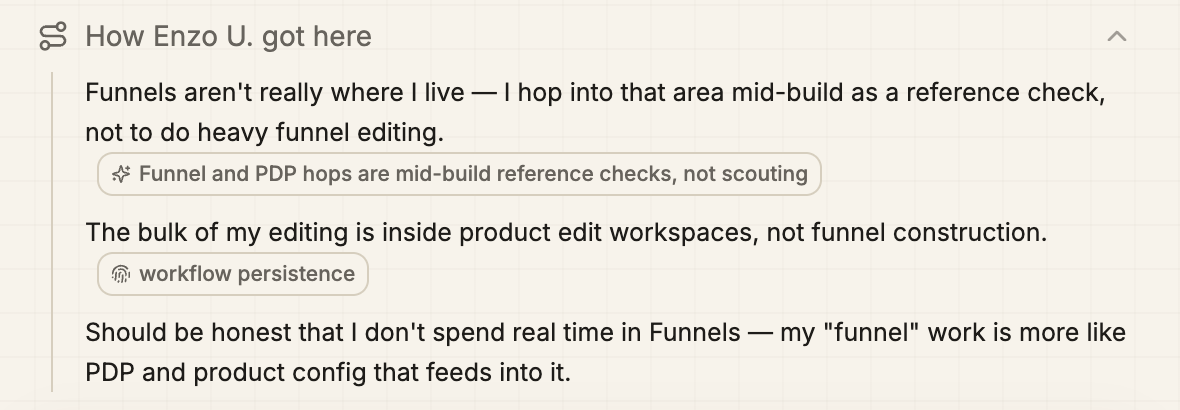
These decision-making traces show what traits, memories and reflections were most heavily referenced when constructing a twin response, anchored against the twin's narrative of how it arrived at a decision.