








How I use august as a designer

Aditi K.
July 20, 2026
august is built to get you closer to your customers, and their insights, faster. Modeled on real people who matter to your business, these digital twins help anyone on your team surface the kind of overlooked insight that usually takes weeks to find, in minutes.
But the question I hear most is: how does this actually fit into my day to day? A marketing lead might use it to see what people gravitate toward in branding. A designer might use it to understand UX patterns. A PM might use it to figure out what actually needs to be prioritized. And so on.
So welcome to a new series, "How I Use august," where we talk to real users about how it fits into their work.
Today, let's start simple: how have I been using august as a product designer?
What is my role, and where does august actually fit into my day to day?
I'm the product designer for august. I've designed everything from the marketing site to the UI/UX of the core product, and august has become my go-to sounding board for that work.
I've been using the new survey feature a lot lately. When I'm stuck between a few design variations, I'll run a survey to see which one resonates more with our customers, and why.
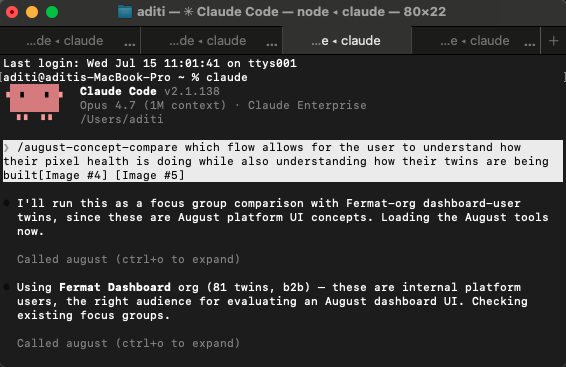
The feature I lean on most is the MCP integration. A lot of our FERMÀT customer types and august customers overlap, so to check whether my designs line up with how customers actually behave, I run focus groups against our dashboard twins. With the MCP tool, I can call august directly from Claude Design: the twins click through a prototype and tell me what's working and what isn't, so I catch misalignment before we ship instead of waiting for live feedback.
That works anywhere a Claude MCP tool can be called. Sometimes I'll do it after pushing new code to the marketing site and get feedback inline in VSCode, then turn that feedback straight into a prompt to edit the design.
Note
Want to call august from Claude Code the way I do? Add the connector with one command:
claude mcp add --transport http august https://mcp.getaugust.ai/mcp
Then run /mcp inside Claude Code to sign in. Full setup for Claude, Cursor and ChatGPT is in our MCP install guide.
august's Claude skills help with something that used to skew a lot of my results too: knowing which questions to ask which users. That part's built in now, so I don't have to guess.
I use Figma less than I used to, but when I do, it's usually alongside august's Figma tool. I'll click on a frame, get immediate feedback, edit the frame, and run that loop until I land on something tailored to what our customers actually want.
In short, august has become my design partner. It gives me feedback and helps me find direction when I don't have any. But I now know that feedback is based on behaviors of our customers and not just a guess.
Before august, how did I get this kind of read on customers or decisions?
Working at a startup means moving fast. More often than not, I didn't have time to set up 1:1 calls or surveys to get direct feedback on a design before it shipped. Most of it came top-down, our FDPMs relaying what customers were telling them. Or we'd bounce ideas back and forth internally using our own industry knowledge, or even use LLMs, feeding them only the context we could provide. There was no real way to test how our true customers behaved before launch, so the process was mostly ship fast, fix fast.
How did I use a twin on a specific design decision before shipping it?
I was working on the pixel training page for our platform, and one thing I asked august about was where to draw the line between being technical with the information we were showing and making pixel health actually digestible to users. The goal was something dynamic and a little magical, but still functional. I mostly called august through Claude Design and ran it through Claude Cowork to make sure the page matched how our pixel actually works.
I used the /concept-compare skill a lot while testing different screens: a group of twins would view the variations, and Claude would summarize what worked and what needed to change. Running that loop is basically how I landed on the design that's live today, which backed in true customer needs and wants while also aligning with what our leadership envisioned for its direction.
Has a twin ever pushed back on a design I liked?
All the time, and the best part is they tell you why. Take the pixel training page. I originally wanted to keep it very technical and functional, just laying out the mechanics clearly. The twins pushed back, not on the content, but on the fact that a purely technical framing gave them no visual pull, so it was hard to actually grasp what was going on or why it mattered.
That reasoning is what makes the feedback useful. It's not just "twins didn't like it," it's a specific, actionable factor: needs a visual hook to convey significance, not just the facts. Before I send anything for review, I run it by them first, and more often than not, there's something to fix.
How do I decide when a twin is enough vs. when I still need a real customer or usability test?
Talking to a real customer is always going to be valuable. Having august alongside that just makes it faster. august is the first layer of feedback, real customer conversations are what confirm it. And because customer behavior keeps shifting as we ship new features, if something I designed isn't landing, the twins make that clear pretty quickly. I still like to set up 1:1 calls when I can, as a final check, but august makes it easier to have that sounding board constantly.
Has august changed how I scope or prioritize design work, not just how I validate it?
Mostly it comes down to time. I don't have to block off time for a long feedback cycle anymore, because as soon as I make a small tweak, I can ask the twins right away. I get to see how they're reasoning through a decision, which surfaces the questions I would've forgotten to ask in an actual customer interview.
Because of the time it takes, I think a lot of designers, myself included, have quietly let customer feedback slide. But it's one of the most important things you can do to push a product in the right direction. august takes away a lot of that friction and still gets me those same insights, and honestly, I've been enjoying the process. Designers, there's really no excuse left to skip your customer research.
Want to see what your own customers would say? august builds digital twins from your real customer data, so you can get an honest reaction to any idea, page, or price in minutes instead of weeks. Try it out.